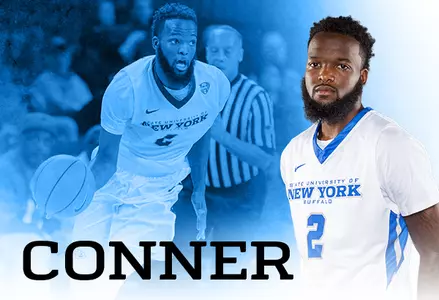
Conner Takes The Long Road To Success
2/19/2016 12:00:00 AM | Men's Basketball
By Sloane Martin
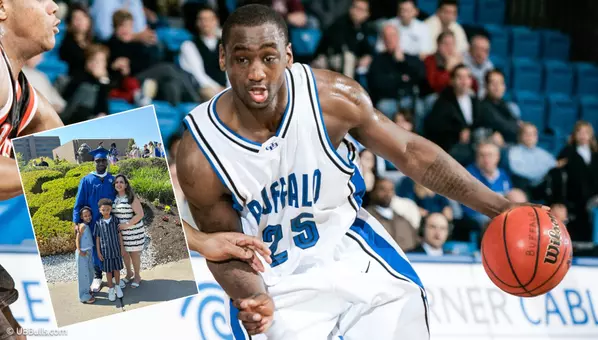
Willie Conner's journey to the University at Buffalo men's basketball team started in a neighborhood in inner-city Chicago.
"Growing up in Chicago, it was pretty tough," he said. "Like a lot of inner cities (there were) gangs, poverty, drugs and stuff like that."
What got him out was the support of his close family who recognized early on that he was destined for more.
"My family, my granddad, mom, dad, uncles, they knew parts of the street life they didn't want me to get into," the junior community college transfer said. "I would go home and see people selling drugs, gambling right on the street, a lot of prostitutes, a lot of all that stuff, so they just made sure I didn't go down that path because they saw I wasn't that kind of kid. They saw that I wanted to do something better. They saw I actually did want to go to school and make it out. They didn't let anything take that away from me."
Basketball also played a major role -- and he knew from a young age that he wanted the sport to be a big part of his life, shielding him from negative outside influences.
The 6-foot-5 guard who loves to shoot was fortunate enough, as he put it, to attend a private Christian school his freshman and sophomore year of high school. Even though the team was successful and he was putting up numbers, Conner didn't feel like he was getting enough exposure against the best competition in the city to attract Division I schools, so he transferred to Richard T. Crane where NBA players Will Bynum, Tony Allen and Sherron Collins graduated from.
Conner flourished there, too, silencing any critics who thought his earlier success was due to inferior competition. He averaged 17 points per game his junior year and 20 his senior year, eventually deciding to advance his career at Florida A&M University in Tallahassee.
His college career would be out on hold, though. The NCAA barred Conner from playing because he was short one credit. The next year, when he eligible, "it was chaos," with a coaching firing and other circumstances. He thought about going back home to play ball, but after talking with his family, decided to reopen his recruitment at the junior college level.
Players who compete at elite levels of community college, like Conner did at Odessa in west Texas, don't lose NCAA eligibility and have a chance to be seen by recruiters. Though he hesitated initially and the fears of injuries or failure crept in, he caught the attention of current Bulls' assistant coach Bryan Hodgson who was an opposing coach at the time. The Bulls were looking for a big wing who could shoot and play defense. Without ever seeing him live, UB head coach Nate Oats liked him immediately based on highlights, statistics and Hodgson's observations and decided to invite him on board.
"He's a tough kid," Oats said of Conner. "He's a leader. His teammates voted him one of the captains." Conner, who has started almost every game this season, has led the team in scoring four times.
At Buffalo, Conner's found a comfortable and competitive environment to grow his game and education, but he already has plans when his career is over: to become a SWAT agent or a probation officer. He wants to use his experience, the environment he was raised in, to put an end to the cycle and assist young people who hail from his same neighborhood.
"I can go back home to Chicago and work with inner city kids," he said. "I know most of the kids who are younger growing up back home anyway, hopefully by that time they won't need me, a probation officer, but they can actually look at someone who's from where they're from and think, OK, maybe I should listen to him, he came from exactly the same streets I came from. He's not an outsider looking in, I actually went through everything that they're going through, saw everything that they saw."
Conner, who has several cousins and younger brothers and sisters, is proud to set an example of someone who left the neighborhood to pursue a college education. But he also thinks he can make a difference for other kids because they can trust his word.
"People that keep going through the system, one, they feel like they don't have to listen to anybody. They think anybody who tells them something is just on them just to get on them and that's really not the case. They can look at me and be like I know him. They know me. They know I'm not telling them (something) just to tell them something, or I'm not just blowing smoke."