Bottorff's Long Journey to UB
4/2/2013 12:00:00 AM | Women's Rowing
BUFFALO, NY – The path to becoming a student-athlete is a similar journey for most. You transition from high school to college, barely an adult, trying to balance being on your own and succeeding both athletically and academically. It is a rare sight to have a 23 year-old freshman join your athletics program, wise beyond her years and ready to take on her next challenge.
Justine Bottorff is a current sophomore on the University at Buffalo's rowing team, but is no ordinary college student-athlete. In 2006, Bottorff was doing what most high school seniors do, applying for colleges. She always had the thought in the back of her mind to join the Army, but did not think it was realistic until a recruiter called her house and it became a reality. While filling out college applications in her statistics class, Justine had an epiphany.
"I don't want to do this, I don't want to go to any of these places, I want to join the Army. I wanted to get experience in the field I was interested in studying (medicine)," Bottorff recalls.
So two weeks after her high school graduation, at a mere 17 years old, Justine was on her way to basic training. For the next four and a half years, she served as a medic in the United States Army.
After basic training, she was sent to Fort Sam Houston for advanced individual training (AIT) for 16 weeks with roughly 500 other medics. She described the military as a very hands-on learning experience. Whatever you did not know, you learned by physically practicing it, not in a classroom.
Bottorff served two tours in Iraq, the first from June 2007 to the end of July 2008. During this deployment, she split her time between being a live medic in a convoy and in an emergency room.
"Convoys …you have FOB-A (forward operating base), which is being 'inside the wire' and there is another FOB at point B. They want to get stuff from point A to point B, so they basically send out a whole bunch of trucks (convoys). It's almost like we were sitting ducks. We were just supposed to deliver supplies, but we'd still get attacked. There is only one major road in Iraq (MSR Tampa), so they knew we were going to be there, so they'd set up IEDs (improvised explosive device)," explained Bottorff when asked about work in a convoy.
Luck seemed to have been on her side during her days in the convoy. When the enemy did attack the fleet of convoys, the convoy in front or behind her were the ones hit. She is quick to note that when a convoy is hit, soldiers do not always get hurt, it is not a death sentence, just very stressful.
She experienced poor leadership in a corrupt unit, which motivated her going into her second tour to display proper leadership as she was promoted in her unit. The amount of activity taking place in Iraq the second time (August 2009 – July 2010) had drastically decreased. She never left the FOB. While there, she worked to help run the hospital, training all those who were new to the system and worked as shift leader.
February 3rd, 2011 was Bottorff's expiration time of service, officially making her a civilian once again. As she began to adjust to normalcy, she started looking into college options. As a veteran, Justine was eligible to have her tuition paid for as long it was a state school. UB was a big school, allowing her to have endless options both in and outside of academics. So in the fall of 2011, she enrolled as a Biomedical major with the hopes of one day becoming a doctor.
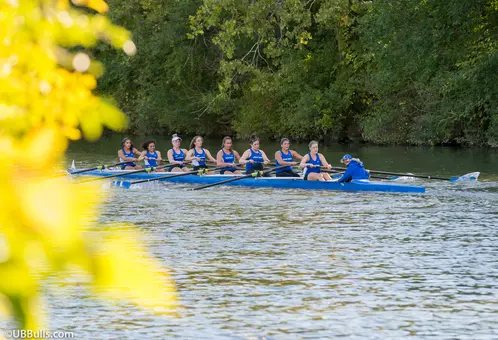
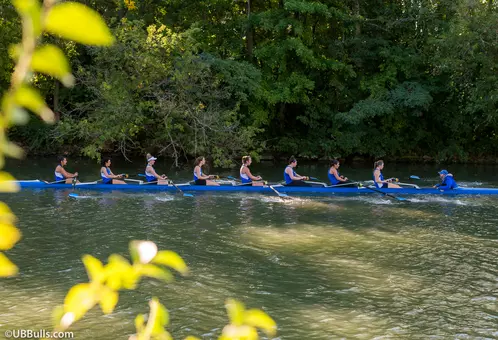
On one of her first days on campus, she received an email encouraging freshmen to tryout for the rowing team.
In that moment, an Iraq War Veteran became a Division I student-athlete. It wasn't smooth transition. Being over five years removed from formal educational structure took its toll.
The adjustment to becoming an athlete was much easier than the adjustment to becoming a student. Growing up, it is always preached that learning is auditory and visual, but because of the Army she was used to learning by doing. She also, realized through her first year's classes that learning about Lewis dot structures was not going to help her in the medical field, after already having so much real life experience in the Army. She changed her major to nursing for a more hands-on learning experience.
She found herself not being able to concentrate or even read a book throughout her freshman year. Unbeknownst to her, she suffered from post-traumatic stress disorder and traumatic brain injury. Although, she had been diagnosed with these conditions, she was not going to let them derail her from success both on and off the water. After a rough first year, she earned a 4.0 grade point average this past fall.
Bottorff had no experience as a rower, but she had no experience when she joined the Army either.
"I like being on a team and I always played sports. I am in shape, I guess I'll be good at it," Bottorff remembers thinking.
As a non-traditional student, rowing became an escape and a support system during her struggles academically as a freshman. She loves having a sense of belonging when she is different than most on campus.
She is the first to admit that she is older than all of her teammates, six years older than some of the freshmen. That has been an experience for her, having seen and been through so much. It has thrown her into a unique leadership role with the team. As an inexperienced rower, she fully admits that she is not looked up to in terms of the sport, but she has gained the respect of her teammates for her life experiences and the journey she took to become their teammate and a part of their family.
"The great thing about Justine is she is not just an excellent athlete, she also is an exceptional teammate," UB head rowing coach Sandy Calfo said. "She is very determined in everything she does, excelling in all aspects of rowing. More than that she is also very aware and supportive of her teammates. When she finishes her workout she gets off the erg and cheers her teammates on. Her experiences have taught her just how important teamwork is and with that she strengthens the team dynamics."
At the end of the day, whether she struggled either academically or athletically, whether she's rowing in the freezing cold, Justine takes a moment to tell herself, her worst days as a student-athlete will never be as bad as some of her days in the Army. That life throws each of us obstacles and it is how we choose to tackle them that define us.
"When things are going well, it's easy to be a good leader, it's easy to be in charge of people that will do what you say and work hard," Bottorff said. "The time that it really matters is when things really go wrong and how you handle it … when classes and practice are going alright, that's easy, but when everything is falling apart and everything is going wrong at the same time. That's when it really matters."
Buffalo will host the Harvey Cup on Tonawanda Creek on April 6.
Written by Athletic Communications Assistant Alex Assimon